Manitoba Hal demonstrates a great variation of an old favourite on the baritone ukulele. This should also be of interest to other uke players as you can play the same chord forms with the usual GCEA tuning in the Key of C.

Manitoba Hal demonstrates a great variation of an old favourite on the baritone ukulele. This should also be of interest to other uke players as you can play the same chord forms with the usual GCEA tuning in the Key of C.
Sometimes when you buy a product it does not always fulfill your expectations or ends up creating unforeseen problems. I have found this to be the case with the Ukulele Straps that I have purchased. Luckily I was able to come up with some creative solutions.
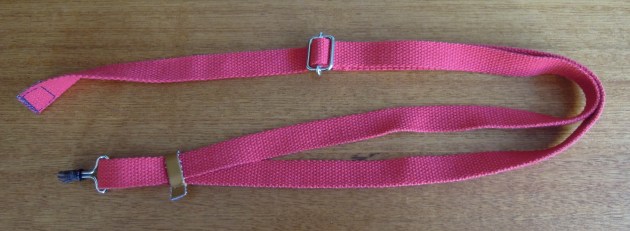
My first Ukulele was concert sized and did not come with a strap button at the base so I bought a common lasso type that hung around my neck with a hook to support the ukulele at the sound hole. I thought that this was the best option, as the ukulele did not have the internal support needed to drill a hole for a strap button. After playing with the lasso strap for I while I found that the neck of my ukulele would wobble around as I played and always felt unstable which did not help my left hand fingering. I thought that if the strap anchored the neck in some way that this would resolve the problem. I had seen the type of straps designed for classical guitars where one end of the strap was tied to the neck and the other end came from behind the guitarists back to hook into the sound hole. I decided to change the lasso strap so that it supported my ukulele in this manner.
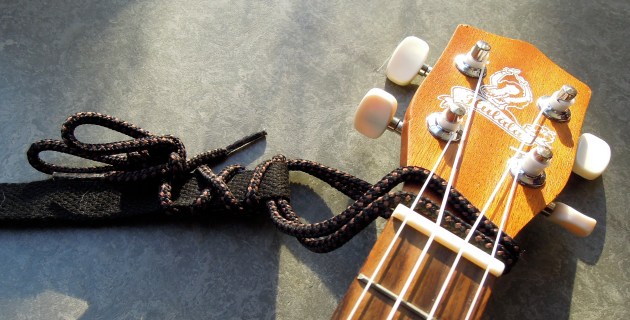
First I undid the strap from its buckle, removed the hook and turned it to face the opposite direction. Next I reinserted the strap into the buckle and adjusted it so that it was long enough to go diagonally over my back and under the ukulele to connect to the bottom of the sound hole at the front. Then I sewed the free end of the strap back on itself to form a loop and ran a strong shoelace through this and tied it to the head under the strings. (a word of caution: don’t let go of the neck or the ukulele will flop forward, come adrift from the strap hook and fall to the floor). Now with the ukulele supported in this way the neck no longer wobbled when I played and I did not need to buy a new strap.
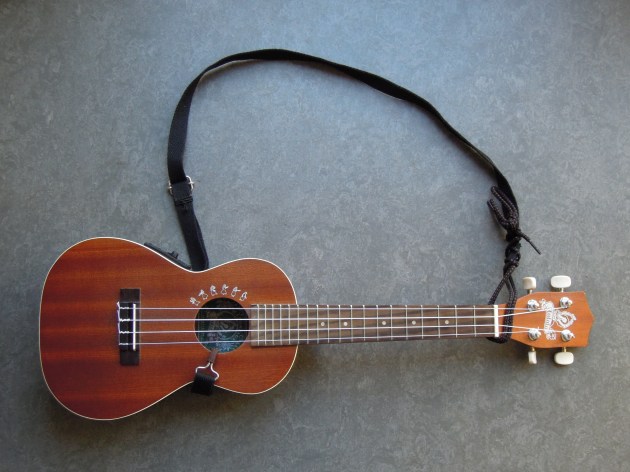
My second ukulele does have a strap button and I first bought a thin leather Mandolin strap, but this always slipped around on my back and drove me crazy. Fortuitously I received a colourful brocade strap as a birthday present that was wider and less likely to slip. It had leather fittings to attach to the neck and strap button. When I went to attach it I found that the leather was very stiff and thick and it was really hard to fix it around the button, which is also the output jack of the electric pick-up. Eventually I managed to get it on. It was quite a tight fit because the jack button was not very deep. Over time the tightness of the strap started to unscrew the jack and that was not very desirable, so I took off the strap. As I really liked it, I decided to shave off some of the leather on the back of the strap with a scalpel blade to reduce the thickness by about half around the jack button. Now the end moves freely without undoing the jack and I can still use my favourite strap.
You don’t need to put up with these irritating problems. There is always a solution and a bit of simple DIY can customize a strap or you could even make your own. So get creative!
Kat, Bayside Ukes Member

You’re on the stage, your throat and mouth go dry, you have shortness of breath and a sick feeling in the stomach. You fumble the chords on your ukulele and the audience seems to morph into a scary monster. You don’t have a virus. You have Stage Fright. If you have never experienced this before, don’t panic. It can happen to anyone, even professional musicians.
After a couple of years occasionally playing with a small group, I experienced a sudden attack of stage fright. At a small community event I made the mistake of focusing on a grumpy looking member of the audience and started to imagine that there was something terribly wrong with my performance. This made me really tense and nervous and I found it difficult to concentrate on my playing. At the time I did not consider that the grouchy faced person may have had a bad day or was unwell and it probably had nothing to do with me.
Once it had manifested I found that this type of anxiety kept happening, so I searched for information about coping with the problem on numerous websites. Here are a few strategies that I find helpful, as well as some I worked out for myself:
Remember to smile and have fun as this is contagious and the feel good aspect of playing the ukulele will prevail.
Kat
Bayside Ukes member.
Someone once told me “you can never have too many ukuleles”. I heartily agree.
For a long time I have been considering the purchase of a second ukulele. The first ukulele I bought was a concert, and I still find it enjoyable to play, however sometimes I have thought it would be nice to buy a second ukulele with a different sound.
The trouble with buying another ukulele is there are so many styles and makes available that it became difficult to make a decision. It is not just about the size of ukulele to buy, whether soprano, concert, tenor, baritone or bass. Or whether it is an acoustic or acoustic/electric. You must also consider whether you want a commercially manufactured ukulele from Australia or overseas, or do you want your ukulele custom made by a luthier to your own specifications. Maybe you would like to build your own ukulele just for fun? In any case you must choose how your ukulele is constructed. This is where buying a ukulele has became more complicated and I referred to several buying guides.
http://coustii.com/types-of-ukuleles/
http://thehub.musiciansfriend.com/folk-instrument-buying-guides/ukuleles-how-to-choose
http://www.get-tuned.com/types-of-ukuleles.php#baritone
http://liveukulele.com/gear/buying-tips/
I found this information very helpful but it not make my decision any easier.
My next line of enquiry was to look at ukulele players to see how they have built their collections. For a start, does the collection show the progression in quality from a cheap ukulele to an expensive ukulele as the collector’s playing ability improved? Or does the collection seem a random mix of ukuleles with different body shapes, woods, finishes and construction methods? Ultimately does the collector continue to play each ukulele? On the Internet you can find many ukulele collections, but I find the most interesting sites are of collectors talking or writing about their ukuleles.
http://www.nutthouse.com.au/ukulele/mystory.html
Both of these collectors seem very passionate about their ukuleles, and I think it is inevitable for players to develop an emotional attachment to their instruments.
As I already owned a concert size ukulele I did not really want to buy another one. I could have looked at a resonator, but another member of our group has one and I thought that two could be too loud at the one time. I ruled out buying a soprano ukulele, as my two arthritic fingers would have trouble negotiating the shorter fret-board and I ruled out a baritone ukulele because it uses guitar tuning. So this narrowed it down to buying a tenor ukulele.
After my research I finally decided it was the moment to buy my second ukulele. I knew I did not have the patience or skill with tools to make my own and I did not want a custom made ukulele from a luthier as my skill as a player is not good enough justify the cost. Also I did not want to buy an instrument online because I wanted try a variety of ukuleles to find the one that was comfortable to play, had a good tone, was visually appealing and was an acoustic/electric. Sometimes it is nice to be loud.
After checking out several music sites online to see what was in stock, I went to a local music store to look for a ukulele. The selection was between three good quality tenor acoustic/electric ukuleles. I did not want to be indecisive and go from store to store so I knew it was between these three ukuleles. There was an eight-string ukulele that sounded rather impressive. In the past I had considered an eight-string ukulele for the different sound it would bring to the group. It was not for me. Unfortunately I found it difficult to play, as I could not always evenly press both strings with my arthritic fingers. Also there was the annoying thought of restringing the eight strings. The other two ukuleles had the usual four strings. Both were beautifully made with a good tone, with fingerboards of the same dimensions and they were the same price. The difference came down to one having slightly deeper sides on the body than the other. This was the one I chose. It has a good tone, is easy to play, it produces a good volume of sound and is pleasant to hold and to look at.
I will not reveal the manufacturer’s name because that is not the point of this article. When you choose a ukulele it is a totally subjective decision that should not be based on advertising and brand recognition. When choosing a ukulele you need to use both your head and your heart and buy the instrument of the best quality you can afford. After all, you will be spending a lot of time together. Happy hunting!
Zilla
Bayside Ukes Member
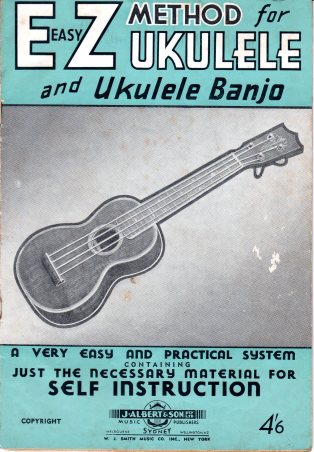
For ukulele aficionados out there, I have discovered a very old uke music book. I was going through my late mother’s music collection and found this:
” The E easy Z
METHOD FOR UKULELE AND UKULELE-BANJO
A very easy and practical system
containing just the necessary material for
SELF-INSTRUCTION.”
Mum was a classical and Jazz pianist in the 1930s and played professionally. I am not sure why she had a uke book. It was probably for someone in the band. It cost four shillings and sixpence or eleven pence posted. This edition was published in Australia by J. Albert & Son Pty Ltd, Sydney, circa. 1935. While the manual has the original copyright for W. J. Smith Music Co. Inc., New York for 1924, it also has two illustrations with the copyright for 1934 and 1935. It must have been an effective teaching method because it is still in print and new editions of this book can be found online.
Interestingly, the tuning of the strings was different: ADF#B. Apparently this was popular in the 1920s and 1930s and considered to make the uke sound brighter and more compatible with guitar chords if you were playing in a band. This would be like playing from the third fret of the soprano ukulele tuned to GCEA.
The book contains a mixture of traditional and old popular songs, including Play It On Your Little Uke.
The EZ method was also considered suitable for other instruments such as the Tiple, Uke-I-Tar, Guitar-Uke, Taropatch. In the book it says that the Guitar-Uke and Uke-I-Tar are other names for the Tenor Guitar that is played like a ukulele. The Taropatch has 4 pairs of strings, each pair tuned to the same note. The Tiple (Tee-plee) is a ten stringed instrument played in pairs or triplets.
A story aside… On the same day I discovered the uke book, I was looking at an old book of Mendelssohn Concertos that my Mum played and three fifty-dollar notes fell out. Paper notes in fact and probably from the 1980s. Imagine? A voice from the grave I reckoned.
Now I am a pretty average uke player, so my tips are not really for the experts, but I play ‘easy’ as they say. My sorry old fingers don’t always reach with appropriate pressure to give a good sound. So I cheat a little. I frequently only play the bottom 2 or 3 strings of a chord, making sure to only strum those strings accordingly. It works very well for say an F Minor or B Flat, or B and many others. This depends on your own fingering capabilities really. Really handy for quick changes and not really noticed in group playing!
Another tip I’m working on is Substitute Chords. Playing at home some of the chords I read are seemingly impossible, or infrequently used and easily forgotten. You can play around and get ‘close’. Once again I’m cheating. For instance G Minor instead of B Flat 7, or C9 instead of EM7 Flat 5. I’m sure many folk know many more. But have a play and see how you go!
Cheers, Helen.
Bayside Ukes member.
Many players always sit when they are playing their ukuleles. While this is fine when doing this for your own pleasure or at ukulele group sessions, it is not ideal in a performance situation and it is better for you physically to stand.
We are repeatedly being told by health care professionals that sitting around for long periods is bad for our health and that it is important to keep moving. Sitting for a long time can make you feel more tired than when doing some physical activity. Playing the ukulele standing up allows your body to move easily in time to the music and is a fun way to lessen sedentary behavior. In addition, it is more difficult to sing strongly in a sitting position because this can constrict the diaphragm. When standing up you can take deeper breaths and it is easier to sing and maintain breath control, something that is also good for the health.
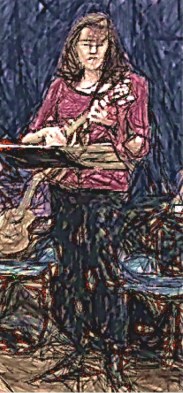
In a performance situation it is usually necessary to stand, especially when playing with a large group that takes up the whole stage or where there are several players on a small stage. Often there is not enough room for everyone to sit, or a supply of chairs to make this possible. If there is no stage at all or one that is low, standing puts the players above the audience and makes it possible to connect with those beyond the front row. It is easier when standing to share music stands amongst several people if needed. This also allows different song leaders on a set list to change positions on stage without any fuss.
Some people find it difficult to play standing up, often because they find it hard to hold their ukulele without resting it on their seated body. It can be tricky balancing your uke without any support, especially the larger sizes, so the obvious solution is to buy a strap. If you have a strap button at the base of the uke, you can use the kind that is a smaller version of a guitar strap and tie the top end under the strings above the neck. Also smaller Mandolin straps are sometimes suitable.
If there is no button on your ukulele it is not recommended that you have one attached, as there might by no internal support into which you can drill the hole. Doing so might cause damage to the body of the ukulele and rather than taking this risk it is better to use the kind of strap that hangs around your neck with an end that hooks into the sound hole to hold the uke. Various types of ukulele straps can be purchased from the same music stores that sell ukuleles, or you can choose from the vast assortment to be found online. Having a strap will allow you to learn to play the ukulele in the standing position and contribute to your enjoyment and performances.
You can build up your stamina by standing for short periods, then increasing the length of time as you get used to this position. Once you can play the ukulele while standing, you will find it is much more fun to be able to move around with the uke, and you will feel more energetic and healthier as a result.
Note: If you need to sit for health reasons make sure that you have frequent breaks from playing and move around.
Kat & Zilla
Bayside Ukes members
Being a self-taught uke player (ukist?), I found there hasn’t been any shortage of help on the web for learning techniques of playing. Ukists around the world are generous beings, sharing their skills and knowledge to help their fellow humans join the fraternity of world ukists.
There is, however, a shortage of information on one matter: uke sizes. I’m not talking about the difference in size between soprano, concert and tenor ukes. That info is widely available. I’m talking about the variation in size between ukes of different brands and how this can impact on the player.
The first uke I ever bought was a tenor Lanikai. I bought it online (from a local store) and was very happy with it. In fact, this is the uke I use mostly today. After having this instrument sit in a green Woolworths shopping bag for months, I decided to buy it a proper home. So I ordered a tenor uke gig bag from the same shop. When it arrived in the post, I was quite cross when I discovered it was the wrong size for my uke – it was way too small. When I rang the shop, they told me that it was definitely a bag for a tenor uke, however, I was told that it was common knowledge (!) that Lanikai ukes are larger than the standard uke. Luckily enough, the music store was kind enough to swap it over with a case (a better quality one, at that) which fitted my slightly over-sized uke. Moral of the story, always take your uke along when buying it a new case.
There is yet another sizing matter people need to know about. After fitting my Lanikai with a low G string (my preference for playing strummed chords), I bought a different brand uke so that I could keep the high G on it to play tabs that need a high G. I tested out ukes during a local uke festival. Price right, tone good, so I bought the uke (it also came with a bag!). I’ve been taking this uke out from time to time when I have the urge to play something more complex. Trouble is, I wasn’t really getting much better at the harder tabs. Then I realised that part of the issue wasn’t me – my newer uke actually has a much wider neck and fingerboard than my Lanikai. I measured the fingerboard of the new uke at the nut and it was 3.8cm, compare to 3.4cm on my trusted Lanikai. For someone with short fingers like me, this makes a real difference.
So why, you may ask, does a short-fingered person like me play tenor ukes? I was totally inspired by the sound made by Jake Shimabukuro on his tenor uke. Here’s one of my favourite performances of him playing his uke:
It’s not very likely that I’d ever play anything that complex – especially with the minimal amount of practice that I do – but hey, one can dream about it.
Mirrie
Bayside Ukes Member
This video tutorial may help you with your ukulele practice.
Spider Scales Tutorial (warm up exercises) by Peter Forrest (Canada).
Pat
Bayside Ukes Member
Arthritis is a problem for many older players of the ukulele and other stringed instruments as it limits flexibility. This should not be seen as an obstacle to playing the ukulele. It does not really matter how you position your hand or form chords as long as you can play them. You do not have to play the ukulele with a perfect technique, although it is good to strive for this even with physical limitations.
I have osteoarthritis in the first and second fingers of my left hand and I am unable to bend these fingers tightly to make a fist. This lack of flexibility makes it difficult to form certain chords on my concert ukulele. The arthritis has caused the joints of these fingers to become enlarged and bent, so reducing the stretch between my second and third fingers. This makes it difficult for two or more fingers to be positioned on the same fret as in the G, D, D7 (Hawaiian) chords.
Instead of positioning my fingers across the fret-board I often hold my hand with the fingers pointing down the fret-board. Unfortunately this does not look very elegant. With my hand in this position I am unable to make a chord transition in the usual way but it is easier to make the transition between D, D7 and G. The disadvantage of this position is when I move my fingers up to the first fret and my hand gets caught up with the headstock. Some chords are also difficult to play using the correct fingering as I have limited stretch between my finger-tips when my fingers are bent. When I play the Gm chord my third finger is unable to make the stretch to the third fret and I must substitute it with my little finger. These are just some of the modifications I make to my technique.
In order to learn a song I must plan all my chord changes to allow for the restricted movement in my left hand. I practice individual chord formations then the transitions between chords so they become smooth and fast. It may take longer to learn a song but I know I shall not be placing undue strain on my finger joints.
With arthritis it is important to be flexible with my approach to chord formation and transitions because there are always exceptions to the rule. What may work for one song, may not work for another. If the transition between chords is really just too hard I find another chord as a substitute or just leave the difficult chord out.
If you also have arthritis do not get disheartened. The important thing to remember is that you need to find out what works for you, persevere with practice and don’t give up. Playing the ukulele will not only strengthen your fingers, improve flexibility and help your arthritis, but more importantly you will have fun while you are doing it.
Ukulele Mike has some exercises that may help improve your flexibility. Dexterity Exercises
Zilla
Bayside Ukes Member
You want to learn to play the ukulele and a little voice in your head says, “It’s too hard” or “I’ll never be able to play it perfectly.” A critical family member or friend may say that you are not musical or you can’t sing so “stop that awful noise.” Well don’t let your inner Demon of Perfectionism or anyone else deny you the pleasure you will gain from playing this fantastic little instrument.
The ukulele is an instrument that you can take up at any age. Even a child can do it. As US performer Amanda Palmer says in her Ukulele Anthem:
“You can play the ukulele too, It is painfully simple,
Play your ukulele badly, Play your ukulele loudly,…….
Limit yourself to three chords, And do not practice daily.”
It is meant to be fun, not a chore. You can be as casual or as serious as you like.
You don’t need to be a musical virtuoso to play the ukulele, as it is primarily a rhythmic and percussive instrument that contributes to the beat of a song. It is easy to sing along with simple chord strums on the ukulele. If you don’t want to sing you can concentrate on fingerpicking the melodies beginning with simple ones. You will get better if you set yourself small goals and will be surprised at how far you can progress.
As for the cost, a basic ukulele is relatively cheap and highly portable. You can take it anywhere to practice. There are also plenty of free resources on-line to help you to learn to play basic chords (see the Links on this website).
Joining a local ukulele group will help you to improve and is a lot of fun. There is no need to feel isolated.
So do yourself a favor and jump into the wonderful world of the Uke!
Kat
Bayside Ukes Member
 baysideukes.com