As we approach Winter in Melbourne and contemplate a cosy fire, would’t it be nice to be on the beach like Taimane Gardner at Waikiki, then in sunny Queensland, Australia for the Cairns Ukulele Festival from the 25-28 August?
Bayside Ukes
As we approach Winter in Melbourne and contemplate a cosy fire, would’t it be nice to be on the beach like Taimane Gardner at Waikiki, then in sunny Queensland, Australia for the Cairns Ukulele Festival from the 25-28 August?
Bayside Ukes
Recently one of Bayside Ukes members attended a local rock band gig where the lead guitarist said something like “ukulele players should have their fingers broken”. What! The performer may have been joking, but I have also been in music stores where sales people have made snide comments about ukulele groups. Why the hostility towards such a harmless genre of music?
Treating the little ukulele as a bit of a joke is not a recent development. In a 1939 Pathé short film about music and musical instruments, the sneering narrator, after praising the piano and various other instruments, refused to believe that the noble Greek Lyre was the father of “this instrument” as the film displayed two young women happily playing ukes. Some of the instruments mentioned in the film have for years become highly institutionalized, with structured teaching syllabuses and exams. While you can have paid lessons, the ukulele has always been an instrument of the people, where knowledge is shared between players and beginners so anyone can learn. You can also play any style of music you like from rock anthems to classical melodies. Maybe this is threatening to some elitist musicians and traditional educators who like to have control over their forms of music. Or maybe the uke is considered to be too cheeky for serious music, hence the snobby attitude towards the uke. Well that’s their problem.
We as ukulele players can be proud of our heritage that includes legends such as George Formby, Tiny Tim and George Harrison. Like other musical genres we have our virtuosos: Jake Shimabukuro; Taimane Gardner; The Ukulele Orchestra of Great Britain, to name a few. We have our rock and pop heroes like Eddie Vedder; Vance Joy; Amanda Palmer and many more. There is a history of actors who have promoted the uke, like Marilyn Monroe and Dwayne “The Rock” Johnson. So there is no need to apologize for being a uker.
All ukers should be congratulated for being part of a grass roots cultural and social movement that has grown from the ordinary person’s need to make their own music and is not directed by “the powers that be.” This is one of the reasons why the ukulele has become so popular. Another reason is that members of the ukulele community enjoy giving their time and energy to entertaining others and this is very rewarding. Think of all the small communities that have benefited from the free ukulele performances in shopping centres, seniors’ facilities, local festivals etc. At a period in history when there is so much gloom and doom in the media, it is wonderful that there are so many people who want to generate some joy.
Let’s ignore the naysayers who are probably envious of the ukes success. There are countless more fans of the ukulele so the detractors have no real power. Individually we may not all be brilliant musicians, but as members of a ukulele community, we can enjoy both the benefits of making music and sharing it with others and after all, that is what playing an instrument is all about.
We can all play our ukuleles with pride. Power to the Uke!
Kat
Bayside Ukes member
Two of the most common strumming patterns for ukulele are the Church Lick and the Calypso Strum. Many beginners may have come across these strums before but know them by no name or different names. If you wish to play with others or play more difficult songs it is important to know the name of the strum pattern being used.
Ukulele Mike has two good videos to demonstrate both of these strumming patterns and they are both in 4/4 time. He also stresses that you must practice both using a straight strum and a swing strum, to the extent that your “muscle memory” allows you to play them both ways automatically. Repetition is the key.
Can be written as:
Ukulele Mike demonstrates this as a Straight 8th note strum and as a Swing 8th note strum. This is also useful for changing chords within a bar (Ukulele Hunt).
Can be written as:
1. / down-down up-up down up / down-down up-up down up /
2. / d.du.udu / d.du.udu /
The Calypso strum is also known as the Island Strum or for guitar players the Rock Strum. It is widely used in popular music and as Ukulele Mike explains in his video, can be played as a Straight 8th note strum or a Swing 8th note strum.
Both songs, He’s Got the World In His Hands and Jamaica Farewell, that Mike mentions as suitable for learning the Calypso strum are in The Ukulele Club Songbook.
Happy Strumming.
Zilla
Bayside Ukes member.
The wonderful Ooks of Hazzard play an up tempo version of Creep at the Swallow Hill Music Denver Ukefest in 2014. Hope they come to Australia in the not too distant future.
Bayside Ukes
Found this beautiful student animation on Youtube. It’s about an old Hawaiian souvenir and his ‘Ukulele Lady’. Great use of the song. There are some talented people out there
Kat
Bayside Ukes member.
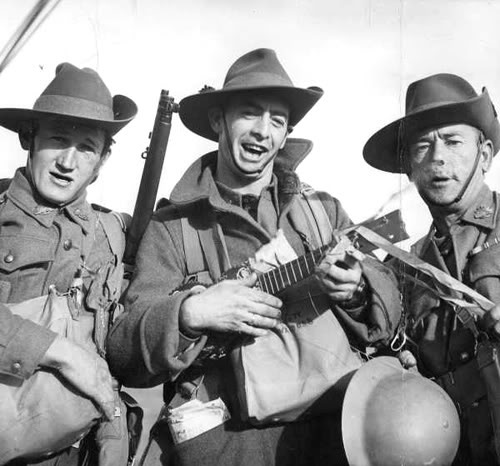
Australian Soldiers WW2
On Anzac Day, the 25th of April, we remember Australians at war.
Although the ukulele was introduced to Australia before 1915, there is little evidence that it was played during World War One by Australian troops at Gallipoli or on the Western Front in Europe. It was not until after 1918 that the huge popularity of the ukulele in America ensured it spread to the rest of the world Ref. 1 . By World War Two Australian soldiers adopted the ukulele as part of their unofficial kit, as they tried to bring some cheer to their lives at camp and at the front.
In America during the 1920s and 1930s, Buster Keaton (and his ukulele), was an established star of silent movies and Cliff “Ukulele Ike” Edwards was famous as a singer and ukulele player in Vaudeville. Both starred in the film “Doughboys” (1930), that loosely depicts Keaton’s wartime experiences during his service in France during WWI Ref 2. One great scene shows Buster and Cliff playing the same ukulele while Cliff sings and Buster scats.
In Australia the ukulele gained popularity during the interwar period. It was appreciated as an entertainment by soldiers in a hospital for war veterans. The Argus (Melbourne, Vic, 25 May 1932, p.6) newspaper reported that Lady Chaytor entertained the patients with her ukulele at the Caulfield Military Hospital. Lady Chaytor was from County Durham, England and had flown to Australia as a passenger in a two seater Gypsy Moth to commence a series of lectures on fashion. Her only luggage was one small suitcase and her ukulele. She visited Caulfield Hospital saying “she felt that she was of the A.I.F., for her brother, who at an early age ran away from home, had enlisted from Queensland”. She visited each of the wards, sat on the piano and sang many songs playing her ukulele and accompanied by the singing of the men.
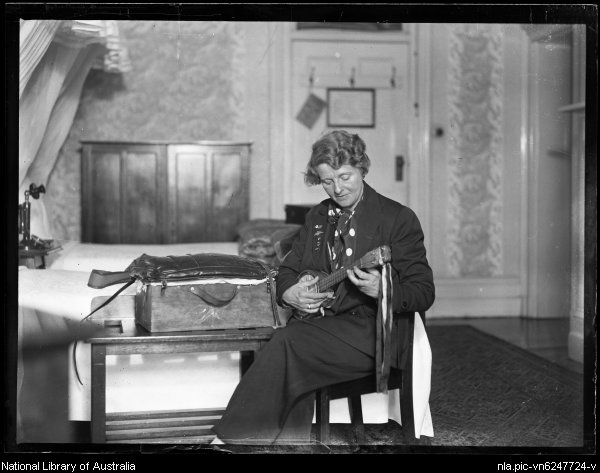
Lady Chaytor with her ukulele in Sydney, Australia, 1932
During World War II George Formby is well-documented entertaining British and allied troops at the front with his banjo ukulele. It is much harder to find photographs and videos of Australian troops being entertained by Australian ukulele performers. Unlike Britain and America, Australia had only a small contingent of entertainers for the diggers during World War Two. The ukulele appears to have been a more private instrument that men could take with them to the battlefield.
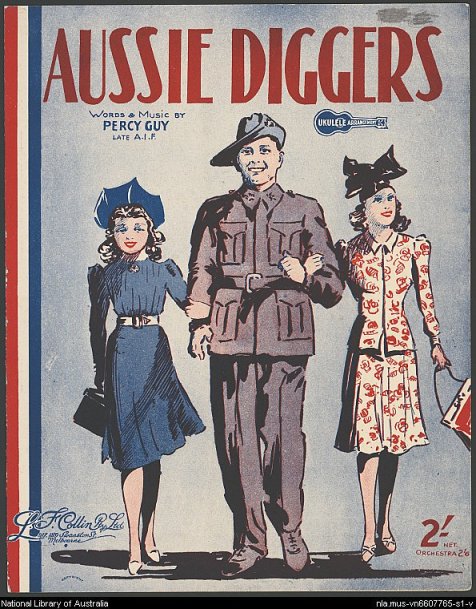
Sheet music for the ukulele became prolific and patriotic during World War Two.
The ukulele and music were very important to many American soldiers during their time in Australia. Jack Earle an American gunner, was recovering in Perth from shell-shock. For him music was “half his life”and he appealed for an instrument in the newspaper after losing two while on active duty. It was quickly replaced the next day by an anonymous female donor (Daily News, Perth W.A. Tues. 16 Sept. 1941, pg. 16) which was only possible due to the popularity of the ukulele in Australia.
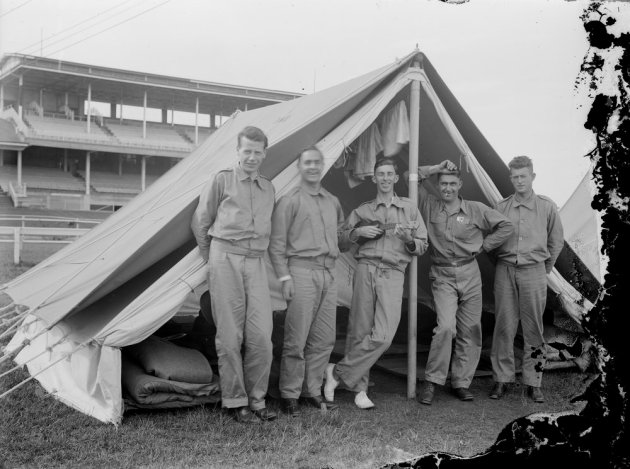
U. S. Marines with ukulele, Ballarat, circa. 1943, Charles Edward Boyles (National Library of Australia).
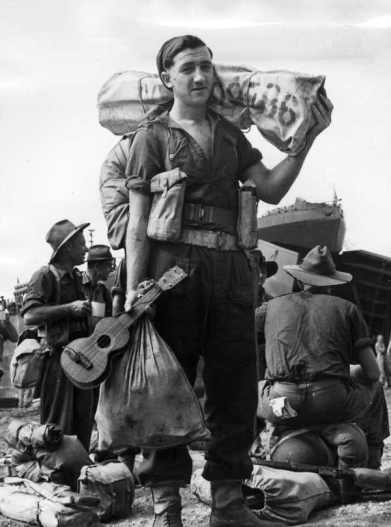
World War 2 Australian Soldier
P.O.W. Whittling Starts WA Ukulele Industry.
Boredom-killing whittling in Changi prisoner of war camp has started up an in-dustry in Western Australia that might become a dollar-earner. Partner in JMG Industries at Jolimont Les O’Connell, filled in his spare time at Changi using a knife on coconut shells and pieces of tea chests to make a ukulele. Heartened by his success he made a carved top ukulele which musicians in the camp hailed as a topline instrument. O’Connell decided to go into the business on his liberation. This story was told today by his partner Jack Maskiell who was with O’Connell in Changi. He said that it took six months to produce the first local ukulele. From then on the ukuleles were marketed throughout Australia with great success. ‘We got a bit cheeky,’ said Maskiell. ‘We sent them to Singapore and Ceylon and now dollar-earning samples are in the U.S.. ‘We also have them in Britain.’ The firm has now produced 3000 ukuleles and 700 guitars…… Maskiell lost a leg in Changi. (The Daily News, Perth, 16 May 1950, pg. 9)
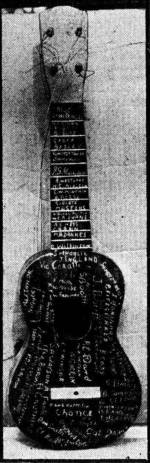
Rats of Tobruk ukulele 1943
After the siege of the Garrison at the Libyan port of Tobruk in 1941 Ref. 3, this ukulele (pictured above) was adopted as a permanent record of the West Australian Battalion known as The Rats of Tobruk. It was owned by a Corporal Smith and played before and during the siege, but became a memento of the event. Pictures of rats were scratched at the headstock with the word Tobruk, then 200 signatures were scratched on the front and back of the ukulele by the men of the unit. It was returned to Western Australia after Corporal Smith was taken prisoner (Daily News, Perth, W.A. Wed, 21 April 1943, pg. 7).
More ukulele stories, photographs and artwork of Australian soldiers can be found in the Australian War Memorial.
The Australian War Memorial – “A Sentimental Song”
Soldiers 1941 – Australian War Memorial
Soldier in Hospital with ukulele – Australian War Memorial
Zilla
Bayside Ukes member.
8. If you are bopping to the music you won’t whack the person next to you in the face because the Uke has a short neck
9. You can do a speech as a Uke song. It makes this less painful for both you and the audience
10. If you play the Uke you belong to a worldwide community of fellow ukers and you need never play alone
So make the most of your Uke. It is such a versatile instrument
Kat
Bayside Ukes member
Taimane Gardner demonstrates her ukulele skills and some moves at the Kamaka stand, NAMM 2016 in Anaheim, 5th February 2016. For those lucky enough to be going up north, she will be performing at the Cairns Ukulele Festival in August.
Bayside Ukes
Now the Easter break is upon us it is time to get in the holiday spirit and kick back, relax and play your ukulele. Gracie Allen had the right idea in the 1939 movie Honolulu. In this clip she is playing her ukulele and singing the song “Honolulu” to Eleanor Powell. It then gets really crazy and they go “tapping” all over the deck. So Hollywood but great fun.
Happy Holidays.
Bayside Ukes
Play your ukulele on Monday the 14th March to celebrate the Labour Day Holiday in Victoria.
We have the Eight Hour Movement of 1856 to thank for introducing the eight hour day to Victoria. The group advocated 8 hours of work, 8 hours of recreation and 8 hours of rest. So let us celebrate those 8 hours of recreation that gives us the time and energy to play our ukuleles.
In 2015 a happy ukulele song really brightened up the morning journey to work for these commuters in Perth, Australia. What a great way to start the working day.
So get out there and play your ukulele.
Happy Labour Day, Melbourne and Victoria.
Zilla
Bayside Ukes Member
 baysideukes.com