
Scales can often seem a chore but Ukulele Mike demonstrates a relatively simple exercise that will strengthen and improve the flexibility of your left-hand fingers. This looks like an exercise that will make a difference while being easy to learn for beginners and for those with less flexible hands.
Tag Archives: Ukulele Tips
Movable Ukulele Chords Tutorial by Manitoba Hal
Another great tutorial from Manitoba Hal to expand your chord and playing knowledge. He explains moveable chords for the ukulele in an easy to understand way.
Blues Tutorial: Manitoba Hal
For those who love the blues here is a more advanced tutorial on how to improve your ukulele blues progressions from Manitoba Hal.
Ukulele Accessories
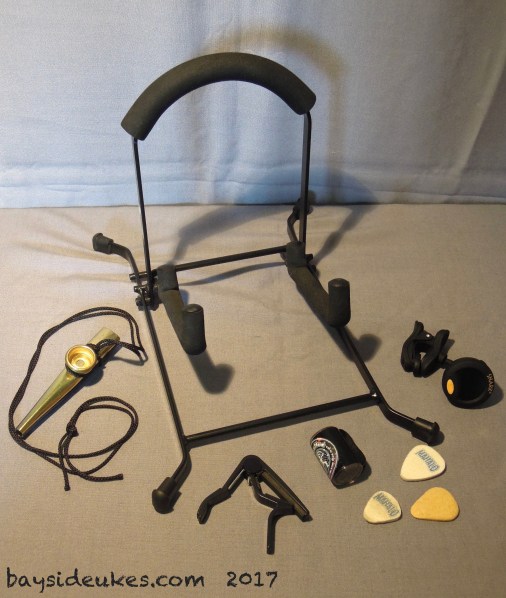
There are a great many accessories available to go with the ukulele and enhance your playing. The Ukulele Hunt website has reviews of many of the types available, so I thought I would just write about what I found to be useful and why. This may give others some idea of what accessories would suit them.
In a previous post I talked about the types of straps that I prefer so I won’t go into these accessories. Probably the main accessory that is essential is a tuner. My two ukuleles have built-in tuners that are really good, but I do keep a Snark clip-on tuner on hand in case of battery failure. The Snark is easy to use and is not affected by any surrounding noise because it works by detecting vibrations. These are small tuners and don’t take up much room in your bag or uke case. There is only one problem. As I have mentioned before puppies and young dogs will eat them if given half the chance, so beware. A Snark is not a dog snack.
When playing on your own it is good to have a capo to change the key without changing your fingering. Although I like to be able to play a song is several keys, sometimes I can’t find exactly the right key to suit my voice without using one that is just too hard for me to play and sing at the same time. This is when a capo is really useful. I have one of the Jim Dunlop clip on ones for ukulele and it is quick and easy to fit to the fret board.
Sometimes I like to use a pick. There are various types of these available for the ukulele. I have some felt and leather ones. I know that you should not use hard plastic picks because these can gouge in the ukulele body and the strings. They also make an irritating clicking sound. The felt ones for ukulele make the least noise but they are rather thick and large, so I used a guitar pick and traced around this on a felt pick with a ballpoint pen and then cut it down to size. I found this easier to control when playing and it is less likely to catch between the strings. The leather ones, while quite large, are thinner and more like a guitar pick so are easy to use and are good if you want a crisper sound.
Ukulele stands are useful, especially if you have more than one ukulele. I have a small folding one. If I have only one ukulele with me, I usually rest it in a chair when I’m not playing. With this type of stand you do need to be careful that the uke is balanced correctly or it can topple over, which defeats its purpose. My ukes are concert sized and if you have a larger sized uke you would definitely need a bigger stand.
A non-essential accessory that is great fun is a finger shaker. You slide it on one of the fingers on your strumming hand and it shakes to the rhythm as you play. This works really well on fast songs.
Another great thing to have is a kazoo. When there is a brass section in a song this makes a fun substitute. And if your kazoo goes soggy and won’t work, replace the insert with a piece of tissue paper or use the transparent window material of an old envelope. It is also a good idea to hang the kazoo from a cord around your neck then you can spit it out when playing and it’s time to sing again without hitting someone.
I have found all of the above accessories to be worthwhile purchases, but do check out what is available. You might find something that you like better.
Happy strumming.
Kat, Bayside Ukes member
Ukulele Lesson: Careless Whisper
What better way to remember a great performer than to keep playing their music. Here is an easy ukulele lesson on how to play the strumming pattern for George Michael’s Careless Whisper given by guitarist and ukulele player Eric Blackmon.
There’s More than One Way to do a Ukulele Song
In a ukulele group there is always a lot of debate about how to do a particular song. Some people think that imitating the original version is the only way to go, while others have their favourite cover version that they like better. Personally, I think that there is no right or wrong way to do a song, but as so many ukulele groups use identical song books and perform the same songs, I believe that a group should do it’s own arrangements. If everyone did things the same way it would be a very boring world.
Coming from a visual art background, I have learnt that it is more creative to develop your own individual form of self-expression. If you painted like Picasso or Monet it would hardly be your own take on the world. The same goes for performing songs. Unless you are a very good impersonator, nobody sounds the same vocally or has the same playing style as the original artist, so why try to replicate that version. Here is where a group needs to forget about the original and play around to find a way that enhances their own sound and gives some room for creativity.
A good example of this is The Ukulele Orchestra of Great Britain’s version of Wuthering Heights by Kate Bush. As a man, George Hinchcliffe has hardly the singing style of Kate Bush, yet he does a wonderful jazzy version of her song that suits his voice, uses the unique sound of the ukulele to full advantage and injects it with the personalities of the group’s members. It just shows that a great song allows so many possibilities for interpretation.
A song with a solo vocalist is also going to sound completely different when done by a large number of singers. If everyone sings the same melody together it could sound very monotonous and possibly messy, which will not add anything to the performance. This is where it pays to rearrange the vocals for a group. For instance, when The Langley Ukulele Ensemble did a ukulele take on Van Morrison’s Brown Eyed Girl, the male ukulele players sang the main vocal together then combined in harmony with the female players. One member did a ukulele solo, while the others strummed and picked the rhythm. Their performance has great clarity and is very appealing. The arrangement makes the most of the large number of performers and enhances their particular sound.
So experiment with a song. Change it to suit the particular voices in the group, whether male of female. This can include altering the key and tempo, as well as introducing various harmonies. With the ukuleles you can change the rhythm patterns or do combinations of compatible strums, and create fingerpicking parts. The ukulele is never going to sound the same as a guitar so work with its particular feel good tone. Don’t be afraid to leave out solos meant for guitar, or if there is a member who feels confident with these, they can do a ukulele solo. The possibilities are endless.
Of course as you gain experience it becomes easier to do your own arrangements. You can start with something simple, like tempo, whether slowing a song down or speeding it up. The main thing is to have an open mind and a willingness to give it a go. If you have trouble, get together with someone else in the group. Two heads are better than one.
Don’t be stuck in a rut or a slave to convention. Try to be as innovative as you can and stamp a song with your group’s unique personality. It will be that much more enjoyable to play and your audience will thank you.
Kat
Getting the most out of Ukulele Festivals
Going to ukulele festivals is great. You get to see many different performers and improve your playing technique by doing workshops over several days and in convenient close proximity to one another. It can be a very inspiring experience but also overwhelming when you have so much choice and new information to absorb. So how can you get the most out of a ukulele festival?
These days many towns and cities all over the world have their own Ukulele festivals that reflect the culture of that particular region and are great to include on an interstate or overseas trip. If you cannot for whatever reason travel far to attend a festival, make the most of those in your hometown or nearby locations. Those easily accessible by car or train can be visited on a day trip if you are unable to stay for the whole festival.
Many festivals offer a discount if you buy advance tickets to several performances. This is good value if you are able to attend most events over the whole of the festival, but not so good if you can only visit on one day. In the latter case you would be better to buy individual tickets for the events that you are able to attend. Many festivals also have plenty of free performances or inexpensive ones that you can go to straight off the street and these are great value.
When faced with a smorgasbord of ukulele workshops it can be difficult to decide which ones would be most beneficial. I use a process of elimination in deciding which workshops to pick. If I have done a workshop before then that is automatically rejected. Secondly I give priority to workshops by overseas performers, as they might not be back to Australia for several years. Thirdly, I choose a workshop with a subject that I have not done before, that will improve my skill and sounds like fun. If you are a beginner it would probably be best to start with the types of workshops that cover new chords and various strumming techniques before moving on to more complex subjects, otherwise you may feel lost and frustrated. You want the experience to be enjoyable.
I find that it is better not to do one workshop straight after another, as it is difficult to assimilate a great amount of new material over a short period of time. Better to learn a few new things well than to struggle with a large amount of new techniques and possibly get things wrong or forget them altogether. So choose workshops that are not held consecutively. A break makes a lot of difference in the prevention of mental fatigue that can hinder your ability to concentrate and retain information.
Take a note pad and write quick notes when you are able during the workshop. This may sound basic but if there is a lot to learn you may not remember everything correctly. When given the chance, ask questions to clarify anything that you find confusing. As soon as possible after you have completed a workshop, sit down and go over what you have learnt to commit the new techniques to your long-term memory. I found after a blues workshop, the sketchy notes that I had taken allowed me to work out the blues chords, progressions and turnarounds. It also helps if you attend a workshop with a friend so that you can compare notes and fill in any gaps that you each may have.
Having the opportunity to meet ukulele players from interstate and overseas is another great benefit of festivals. Often these performers sell their CDs directly to their audience or in the festival market hall. If you can, have a chat with some of them and buy a CD or a teaching DVD, as these are less expensive at festivals, often hard to find locally and are a great way of hearing more of the performers music and learning something new. In 2014 a friend and I had the pleasure of having a chat with Jim D’Ville in the market hall of the Melbourne Ukulele festival. We had been unable to attend his workshop and he generously gave us, and those nearby, a mini talk about his technique of playing by ear. We wanted to find out more and bought his DVD lessons. So talk and listen to other players. It will make your experience that much more interesting and entertaining.
Even if you can attend only one day of a festival you should be able to enjoy many performances, add to your ukulele playing techniques and have a great time. They are a fantastic community resource.
Kat
Bayside Ukes member

Making Time For Your Ukulele
It is springtime down under, and in Melbourne, as opposed to the far north of Australia, we have the benefit of enjoying the four seasons, sometimes even in one day. In spring there is a lot to do in the garden so my ukulele has been rather neglected lately. Life can get busy for various reasons and this got me thinking about how to make sure that you give time to your ukulele no matter what the circumstances.
As I help to run a Ukulele Group I need to prepare for the next session. I always devote some time for this at least one day in advance and on the Tuesday afternoon before we meet in the evening. These times are set aside for song preparation and ukulele practice. Making a regular appointment with your ukulele is a good method to ensure that you do not forget to put in some practice. You would not miss an appointment made with a professional service provider or a friend without a very good reason and you should treat your ukulele with the same respect. This is easy to justify, as playing an instrument is good for you as well as fun.
Another way to keep up your practice is to always keep your ukulele handy so that you can pick it up when you have a free moment. Just be careful if you have a puppy or small child in the vicinity or you might find that it disappears or gains tooth marks. In these cases it is probably best to have an inexpensive instrument lying around. It is amazing how a few minutes here and there can add up to a lot of playing time.
If you live in a noisy environment where there are a lot of demands on your time, it is a good idea to have some sort of bolt hole where you can play undisturbed or take your opportunity when no one is around. If you are really lucky you may have a dedicated music room or maybe it is time to clean out that junk room, attic or basement and claim it for your own. You could also use the garage or garden shed if your home is too crowded. On a fine day playing under a shady tree would do or you could go to the local park (provided they don’t have those draconian laws against playing musical instruments in a public place). Find a quiet place where you won’t disturb anyone, not that the ukulele is very loud. If no one can track you down, you will have no more interruptions.
Playing with others provides good motivation. Having a “study buddy” is a great help when you are doing a course at university and this will work for the ukulele. If you regularly play with another person it will give you incentive to keep up your practice, as you won’t want to let someone else down. You could alternate playing at each other’s homes to lessen complaints from other housemates or family members. Just an hour’s practice together a week should be enough to make a big difference.
As the saying goes “if you want something done always ask a busy person”, so you should be able to find some time to give to your uke. Now that my garden is tidy, I am looking forward to many fine spring and summer days when I can spend any free moments outside and play my ukulele.
Kat
Bayside Ukes Member
Baritone Uke Tutorial
Manitoba Hal demonstrates a great variation of an old favourite on the baritone ukulele. This should also be of interest to other uke players as you can play the same chord forms with the usual GCEA tuning in the Key of C.
UKULELE STRAPS: One Size does not fit all
Sometimes when you buy a product it does not always fulfill your expectations or ends up creating unforeseen problems. I have found this to be the case with the Ukulele Straps that I have purchased. Luckily I was able to come up with some creative solutions.
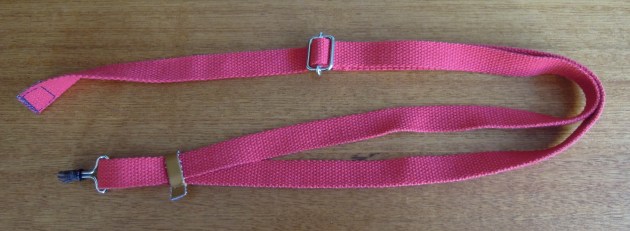
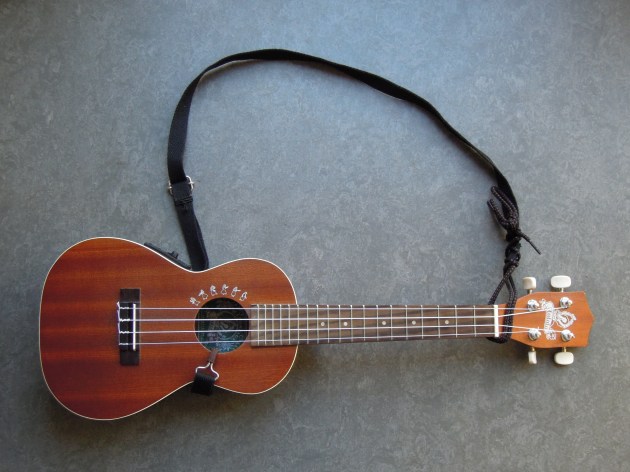
My first Ukulele was concert sized and did not come with a strap button at the base so I bought a common lasso type that hung around my neck with a hook to support the ukulele at the sound hole. I thought that this was the best option, as the ukulele did not have the internal support needed to drill a hole for a strap button. After playing with the lasso strap for I while I found that the neck of my ukulele would wobble around as I played and always felt unstable which did not help my left hand fingering. I thought that if the strap anchored the neck in some way that this would resolve the problem. I had seen the type of straps designed for classical guitars where one end of the strap was tied to the neck and the other end came from behind the guitarists back to hook into the sound hole. I decided to change the lasso strap so that it supported my ukulele in this manner.
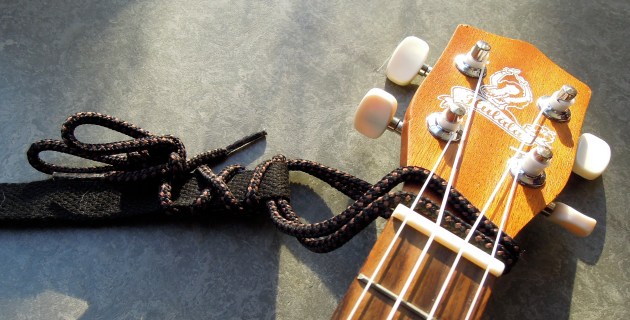
First I undid the strap from its buckle, removed the hook and turned it to face the opposite direction. Next I reinserted the strap into the buckle and adjusted it so that it was long enough to go diagonally over my back and under the ukulele to connect to the bottom of the sound hole at the front. Then I sewed the free end of the strap back on itself to form a loop and ran a strong shoelace through this and tied it to the head under the strings. (a word of caution: don’t let go of the neck or the ukulele will flop forward, come adrift from the strap hook and fall to the floor). Now with the ukulele supported in this way the neck no longer wobbled when I played and I did not need to buy a new strap.
My second ukulele does have a strap button and I first bought a thin leather Mandolin strap, but this always slipped around on my back and drove me crazy. Fortuitously I received a colourful brocade strap as a birthday present that was wider and less likely to slip. It had leather fittings to attach to the neck and strap button. When I went to attach it I found that the leather was very stiff and thick and it was really hard to fix it around the button, which is also the output jack of the electric pick-up. Eventually I managed to get it on. It was quite a tight fit because the jack button was not very deep. Over time the tightness of the strap started to unscrew the jack and that was not very desirable, so I took off the strap. As I really liked it, I decided to shave off some of the leather on the back of the strap with a scalpel blade to reduce the thickness by about half around the jack button. Now the end moves freely without undoing the jack and I can still use my favourite strap.
You don’t need to put up with these irritating problems. There is always a solution and a bit of simple DIY can customize a strap or you could even make your own. So get creative!
Kat, Bayside Ukes Member
 baysideukes.com