Ukulele Songs About Ukuleles

Ukulele songs about ukuleles.  This is a great genre for groups so I thought I’d have a look on the net to see how many I could find.  There are a number of songs from the 1920’s and 30s but not so many from later periods, unless they are just unrecorded, unavailable on the net or only found in ukulele music books.

From the early days of the uke, some of the songs mentioned on the Ukulele Hunt website (Ukulele Songs) are Ukulele Moon and Ukulele Island, but I could not find them in cyberspace.  Pity, they sounded interesting.

One of the most famous songs from the early period that is still madly popular is of course Ukulele Lady.  A great live version by Bette Midler (not the distorted video version) has disappeared from YouTube but here is a fun one by the Muppets.

Amusing songs about the ukulele were performed by those stalwarts of the 30s and 40s, George Formby and Cliff Edwards.

Here’s  George doing With My Little Ukulele In My Hand from the movie Off The Dole (1935)

Another funny song is I Did It With My Little Ukulele sung be Cliff “Ukulele Ike” Edwards in the 1933 movie Take A Chance.  It contains a typical flash back sequence of the period with stereotypical cannibals and hula dancers.

Other songs that I found on YouTube are I Love A Ukulele performed by Annette Hanshaw (1930) and I Love To Play My Ukulele  by Max Bygraves (1958).

Recent songs about the ukulele are harder to find.  There are plenty of new songs written for the ukulele, like Charlie Roe’s Ukulele Song and Vance Joy’s Riptide, but these do not refer to the ukulele in the lyrics.

A good one I did find is Ukulele Central written and performed by Fairport Convention in 2010.  It gives a short hilarious history of the ukulele.

Most ukulele players by now would have heard the fabulous Amanda Palmer’s Ukulele Anthem. Here she is performing it outside the Sydney Opera House.

Another fairly recent song is A Ukulele and You by Jim Berloff (2005), one of the compilers of The Daily Ukulele and other song books.  Here is a version performed by Ukester Brown:

A Ukulele and You

Some ukulele groups adapt existing popular songs so that they are about ukuleles and can be played on the uke.  Here is an example:

Blame It On The Ukulele 

If you wanted, it would be relatively easy to adapt a song yourself or you could write an original song about ukuleles.

I am sure that there must be more ukulele songs about the ukulele out there so have a look around.  It really does take you on a small journey into the history of the uke.

Kat

Bayside Ukes Member

Bayside Ukes Sessions 2017

BaysideUkesLogo

Bayside Ukes returns to the Hampton Community Centre on Tuesday, January 31 at 7 pm.

We hope everyone had a great holiday break and that you are all raring to play at our group sessions.  Looking forward to seeing you all there.  New members are always welcome.

Kat  and Zilla,  Bayside Ukes Members

There’s More than One Way to do a Ukulele Song

In a ukulele group there is always a lot of debate about how to do a particular song.  Some people think that imitating the original version is the only way to go, while others have their favourite cover version that they like better.  Personally, I think that there is no right or wrong way to do a song, but as so many ukulele groups use identical song books and perform the same songs, I believe that a group should do it’s own arrangements.  If everyone did things the same way it would be a very boring world.

Coming from a visual art background, I have learnt that it is more creative to develop your own individual form of self-expression.  If you painted like Picasso or Monet it would hardly be your own take on the world.  The same goes for performing songs.  Unless you are a very good impersonator, nobody sounds the same vocally or has the same playing style as the original artist, so why try to replicate that version.  Here is where a group needs to forget about the original and play around to find a way that enhances their own sound and gives some room for creativity.

A good example of this is The Ukulele Orchestra of Great Britain’s version of Wuthering Heights by Kate Bush.  As a man, George Hinchcliffe has hardly the singing style of Kate Bush, yet he does a wonderful jazzy version of her song that suits his voice, uses the unique sound of the ukulele to full advantage and injects it with the personalities of the group’s members.  It just shows that a great song allows so many possibilities for interpretation.

A song with a solo vocalist is also going to sound completely different when done by a large number of singers.  If everyone sings the same melody together it could sound very monotonous and possibly messy, which will not add anything to the performance.  This is where it pays to rearrange the vocals for a group.  For instance, when The Langley Ukulele Ensemble did a ukulele take on Van Morrison’s Brown Eyed Girl, the male ukulele players sang the main vocal together then combined in harmony with the female players.  One member did a ukulele solo, while the others strummed and picked the rhythm.  Their performance has great clarity and is very appealing.  The arrangement makes the most of the large number of performers and enhances their particular sound.

So experiment with a song.  Change it to suit the particular voices in the group, whether male of female.  This can include altering the key and tempo, as well as introducing various harmonies.  With the ukuleles you can change the rhythm patterns or do combinations of compatible strums, and create fingerpicking parts.  The ukulele is never going to sound the same as a guitar so work with its particular feel good tone.  Don’t be afraid to leave out solos meant for guitar, or if there is a member who feels confident with these, they can do a ukulele solo.  The possibilities are endless.

Of course as you gain experience it becomes easier to do your own arrangements.  You can start with something simple, like tempo, whether slowing a song down or speeding it up. The main thing is to have an open mind and a willingness to give it a go.  If you have trouble, get together with someone else in the group.  Two heads are better than one.

Don’t be stuck in a rut or a slave to convention.  Try to be as innovative as you can and stamp a song with your group’s unique personality.  It will be that much more enjoyable to play and your audience will thank you.

Kat

Singing in Ukulele Groups

Singing with a group is different from singing on your own. You must try to harmonise with the other voices, as not everyone can easily sing in the particular key of a song.  It helps if you have had some singing lessons.  Before taking up the Ukulele I learnt to sing a cappella, that is, unaccompanied by an instrument, in a small group class. We learnt how to find our vocal range and to sing different parts in three or four-part harmonies.  It was great experience for singing in a Ukulele group, but anyone can learn to sing in harmony.

It takes practice to hold your part with other singers, but it helps if you sit or stand next to someone with the same vocal range.  Over time and by listening to the other members of the group, you should be able to do this with ease and without damaging your voice by singing out of your range.  It is well worth the effort to persevere with harmony singing and it will give your ukulele group a more integrated sound.

A good way to develop the harmonies for a song is to sing them unaccompanied before bringing in the ukuleles.  You can then tell if they are working and that everyone is in sync before adding the instruments.  This makes for tighter vocals and allows everyone to learn their parts.

I have also noticed that in some larger ukulele groups not everyone plays their instrument when they are singing.  This tones down the volume of multiple ukuleles and makes it easier for the singers to hear their harmonies.  When you are doing tight harmony singing it takes a lot of concentration and it is probably better if you do not have to think about what you are playing at the same time.  Also soloist singers in a group often do not play their ukuleles because they are putting all their effort into the vocals.

A good example of the above technique can be seen in the performances of the Langley Ukulele Ensemble from British Columbia.  They perform beautiful vocal harmonies and vary the numbers of those playing their ukuleles. Below is a video of a performance that they did this year in Hawaii.

So don’t worry if you find it difficult to play the ukulele and sing harmonies simultaneously.  If there are enough ukulele players in the group, it is not detrimental that you do not play your instrument while you are singing  and this can improve the overall sound.

Kat

Bayside Ukes Resumes 12 July

BaysideUkesLogo

Hi Everyone,

Bayside Ukes will return to the Hampton Community Centre next week on Tuesday 12 July at 7pm.

New members are welcome to join our friendly group of ukulele players.  Please be on time to register for the evening.  The session will begin at 7:15 sharp and remember to bring your copy of The Ukulele Club Songbook and a music stand.

We hope everyone had a fabulous holiday break.  If you have not picked up your ukulele because of too much holiday cheer, now is the time to start practising.

We would also like to thank those members of the group who gave up two days of their holiday to perform for two local groups of senior citizens.  We all had a great time.

This term we plan to be doing more performances so get ready to learn some new songs.

The two ten week term dates for the second half of the year are:

TERM 3:  12th July – 13th September

TERM 4 : 4th October – 13th December

The Benefits of Standing when Playing the Ukulele

Many players always sit when they are playing their ukuleles.  While this is fine when doing this for your own pleasure or at ukulele group sessions, it is not ideal in a performance situation and it is better for you physically to stand.

We are repeatedly being told by health care professionals that sitting around for long periods is bad for our health and that it is important to keep moving.  Sitting for a long time can make you feel more tired than when doing some physical activity.  Playing the ukulele standing up allows your body to move easily in time to the music and is a fun way to lessen sedentary behavior.  In addition, it is more difficult to sing strongly in a sitting position because this can constrict the diaphragm.  When standing up you can take deeper breaths and it is easier to sing and maintain breath control, something that is also good for the health.

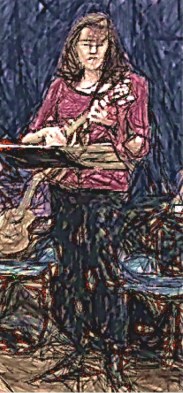
Standing uke drawing copy

In a performance situation it is usually necessary to stand, especially when playing with a large group that takes up the whole stage or where there are several players on a small stage.  Often there is not enough room for everyone to sit, or a supply of chairs to make this possible.  If there is no stage at all or one that is low, standing puts the players above the audience and makes it possible to connect with those beyond the front row.  It is easier when standing to share music stands amongst several people if needed.  This also allows  different song leaders on a set list to change positions on stage without any fuss.

Some people find it difficult to play standing up, often because they find it hard to hold their ukulele without resting it on their seated body.  It can be tricky balancing your uke without any support, especially the larger sizes, so the obvious solution is to buy a strap.  If you have a strap button at the base of the uke, you can use the kind that is a smaller version of a guitar strap and tie the top end under the strings above the neck.  Also smaller Mandolin straps are sometimes suitable.

If there is no button on your ukulele it is not recommended that you have one attached, as there might by no internal support into which you can drill the hole.  Doing so might cause damage to the body of the ukulele and rather than taking this risk it is better to use the kind of strap that hangs around your neck with an end that hooks into the sound hole to hold the uke.  Various types of ukulele straps can be purchased from the same music stores that sell ukuleles, or you can choose from the vast assortment to be found online.  Having a strap will allow you to learn to play the ukulele in the standing position and contribute to your enjoyment and performances.

You can build up your stamina by standing for short periods, then increasing the length of time as you get used to this position.  Once you can play the ukulele while standing, you will find it is much more fun to be able to move around with the uke, and you will feel more energetic and healthier as a result.

Note: If you need to sit for health reasons make sure that you have frequent breaks from playing and move around.

Kat & Zilla

Bayside Ukes members

Flexible Chords for Inflexible Hands

Arthritis is a problem for many older players of the ukulele and other stringed instruments as it limits flexibility.  This should not be seen as an obstacle to playing the ukulele.  It does not really matter how you position your hand or form chords as long as you can play them.  You do not have to play the ukulele with a perfect technique, although it is good to strive for this even with physical limitations.

I have osteoarthritis in the first and second fingers of my left hand and I am unable to bend these fingers tightly to make a fist.  This lack of flexibility makes it difficult to form certain chords on my concert ukulele.  The arthritis has caused the joints of these fingers to become enlarged and bent, so reducing the stretch between my second and third fingers.  This makes it difficult for two or more fingers to be positioned on the same fret as in the G, D, D7 (Hawaiian) chords.

Instead of positioning my fingers across the fret-board I often hold my hand with the fingers pointing down the fret-board.  Unfortunately this does not look very elegant.  With my hand in this position I am unable to make a chord transition in the usual way but it is easier to make the transition between D, D7 and G.  The disadvantage of this position is when I move my fingers up to the first fret and my hand gets caught up with the headstock.  Some chords are also difficult to play using the correct fingering as I have limited stretch between my finger-tips when my fingers are bent.  When I play the Gm chord my third finger is unable to make the stretch to the third fret and I must substitute it with my little finger.  These are just some of the modifications I make to my technique.

In order to learn a song I must plan all my chord changes to allow for the restricted movement in my left hand.  I practice individual chord formations then the transitions between chords so they become smooth and fast.  It may take longer to learn a song but I know I shall not be placing undue strain on my finger joints.

With arthritis it is important to be flexible with my approach to chord formation and transitions because there are always exceptions to the rule.  What may work for one song, may not work for another.  If the transition between chords is really just too hard I find another chord as a substitute or just leave the difficult chord out.

If you also have arthritis do not get disheartened.  The important thing to remember is that you need to find out what works for you, persevere with practice and don’t give up.  Playing the ukulele will not only strengthen your fingers, improve flexibility and help your arthritis, but more importantly you will have fun while you are doing it.

Ukulele Mike has some exercises that may help improve your flexibility.  Dexterity Exercises

Zilla

Bayside Ukes Member

Welcome Back!

BaysideUkesLogo

Bayside Ukes will return to the Hampton Community Centre next week on Tuesday 2nd February at 7pm.  Please be on time as members will need to register for the year.  The session will begin at 7:15 sharp and remember to bring your copy of The Ukulele Club Songbook.  This year the Hampton Community Centre has increased their Fee to $6.00 a person per session.

We hope everyone had a fabulous holiday break.  If you have not picked up your ukulele because of too much holiday cheer, now is the time to start practising.

We look forward to seeing you at our first session.  New members are welcome to join our friendly group of ukulele players.

Check out this ukulele version of Welcome Back.


Who says You can’t play the Ukulele?

You want to learn to play the ukulele and a little voice in your head says, “It’s too hard” or “I’ll never be able to play it perfectly.”  A critical family member or friend may say that you are not musical or you can’t sing so “stop that awful noise.”  Well don’t let your inner Demon of Perfectionism or anyone else deny you the pleasure you will gain from playing this fantastic little instrument.

The ukulele is an instrument that you can take up at any age.  Even a child can do it.  As US performer Amanda Palmer says in her Ukulele Anthem:

             “You can play the ukulele too, It is painfully simple,

Play your ukulele badly, Play your ukulele loudly,…….

        Limit yourself to three chords,  And do not practice daily.”

It is meant to be fun, not a chore.  You can be as casual or as serious as you like.

You don’t need to be a musical virtuoso to play the ukulele, as it is primarily a rhythmic and percussive instrument that contributes to the beat of a song.  It is easy to sing along with simple chord strums on the ukulele.  If you don’t want to sing you can concentrate on fingerpicking the melodies beginning with simple ones.  You will get better if you set yourself small goals and will be surprised at how far you can progress.

As for the cost, a basic ukulele is relatively cheap and highly portable.  You can take it anywhere to practice.  There are also plenty of free resources on-line to help you to learn to play basic chords (see the Links on this website).

Joining a local ukulele group will help you to improve and is a lot of fun.  There is no need to feel isolated.

So do yourself a favor and jump into the wonderful world of the Uke!

Kat

Bayside Ukes Member