My Second Ukulele

Someone once told me “you can never have too many ukuleles”. I heartily agree.

For a long time I have been considering the purchase of a second ukulele.  The first ukulele I bought was a concert, and I still find it enjoyable to play, however sometimes I have thought it would be nice to buy a second ukulele with a different sound.

The trouble with buying another ukulele is there are so many styles and makes available that it became difficult to make a decision.  It is not just about the size of ukulele to buy, whether soprano, concert, tenor, baritone or bass.  Or whether it is an acoustic or acoustic/electric.  You must also consider whether you want a commercially manufactured ukulele from Australia or overseas, or do you want your ukulele custom made by a luthier to your own specifications.  Maybe you would like to build your own ukulele just for fun?  In any case you must choose how your ukulele is constructed.  This is where buying a ukulele has became more complicated and I referred to several buying guides.

http://coustii.com/types-of-ukuleles/

http://thehub.musiciansfriend.com/folk-instrument-buying-guides/ukuleles-how-to-choose

http://www.get-tuned.com/types-of-ukuleles.php#baritone

http://liveukulele.com/gear/buying-tips/

I found this information very helpful but it not make my decision any easier.

My next line of enquiry was to look at ukulele players to see how they have built their collections.  For a start, does the collection show the progression in quality from a cheap ukulele to an expensive ukulele as the collector’s playing ability improved?  Or does the collection seem a random mix of ukuleles with different body shapes, woods, finishes and construction methods?  Ultimately does the collector continue to play each ukulele?  On the Internet you can find many ukulele collections, but I find the most interesting sites are of collectors talking or writing about their ukuleles.

http://www.nutthouse.com.au/ukulele/mystory.html

Both of these collectors seem very passionate about their ukuleles, and I think it is inevitable for players to develop an emotional attachment to their instruments.

As I already owned a concert size ukulele I did not really want to buy another one.  I could have looked at a resonator, but another member of our group has one and I thought that two could be too loud at the one time.  I ruled out buying a soprano ukulele, as my two arthritic fingers would have trouble negotiating the shorter fret-board and I ruled out a baritone ukulele because it uses guitar tuning.  So this narrowed it down to buying a tenor ukulele.

After my research I finally decided it was the moment to buy my second ukulele.  I knew I did not have the patience or skill with tools to make my own and I did not want a custom made ukulele from a luthier as my skill as a player is not good enough justify the cost.  Also I did not want to buy an instrument online because I wanted try a variety of ukuleles to find the one that was comfortable to play, had a good tone, was visually appealing and was an acoustic/electric.  Sometimes it is nice to be loud.

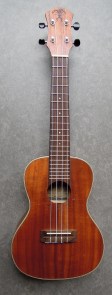
After checking out several music sites online to see what was in stock, I went to a local music store to look for a ukulele.  The selection was between three good quality tenor acoustic/electric ukuleles.  I did not want to be indecisive and go from store to store so I knew it was between these three ukuleles.  There was an eight-string ukulele that sounded rather impressive.  In the past I had considered an eight-string ukulele for the different sound it would bring to the group.  It was not for me.  Unfortunately I found it difficult to play, as I could not always evenly press both strings with my arthritic fingers.  Also there was the annoying thought of restringing the eight strings.  The other two ukuleles had the usual four strings.  Both were beautifully made with a good tone, with fingerboards of the same dimensions and they were the same price.  The difference came down to one having slightly deeper sides on the body than the other.  This was the one I chose.  It has a good tone, is easy to play, it produces a good volume of sound and is pleasant to hold and to look at.

I will not reveal the manufacturer’s name because that is not the point of this article.  When you choose a ukulele it is a totally subjective decision that should not be based on advertising and brand recognition.  When choosing a ukulele you need to use both your head and your heart and buy the instrument of the best quality you can afford.  After all, you will be spending a lot of time together.  Happy hunting!

Zilla

Bayside Ukes Member
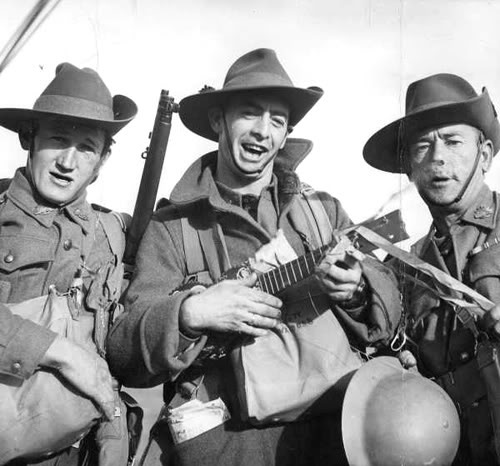
The Ukulele and the Troops

98b2b5133eccdc0c80805e0f227c8a44

Australian Soldiers WW2

On Anzac Day, the 25th of April, we remember Australians at war.

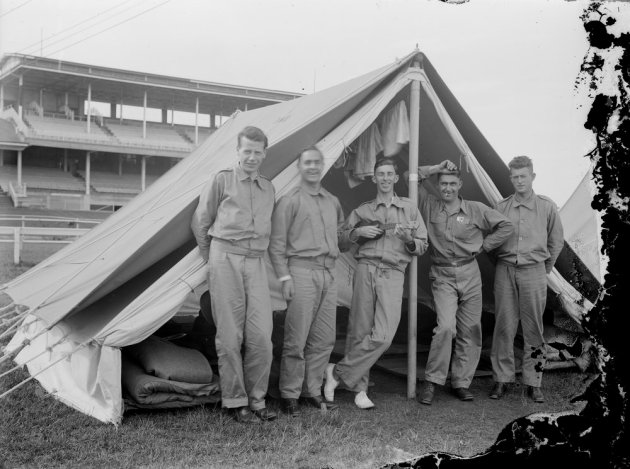
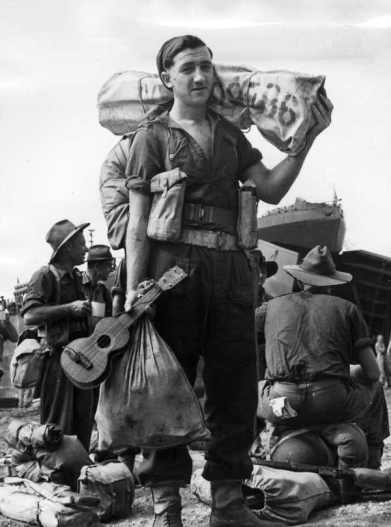
Although the ukulele was introduced to Australia before 1915, there is little evidence that it was played during World War One by Australian troops at Gallipoli or on the Western Front in Europe.  It was not until after 1918 that the huge popularity of the ukulele in America ensured it spread to the rest of the world Ref. 1 .  By World War Two Australian soldiers adopted the ukulele as part of their unofficial kit, as they tried to bring some cheer to their lives at camp and at the front.

In America during the 1920s and 1930s, Buster Keaton (and his ukulele), was an established star of silent movies and Cliff “Ukulele Ike” Edwards was famous as a singer and ukulele player in Vaudeville.  Both starred in the film “Doughboys” (1930), that loosely depicts Keaton’s wartime experiences during his service in France during  WWI  Ref 2.  One great scene shows Buster and Cliff playing the same ukulele while Cliff sings and Buster scats.

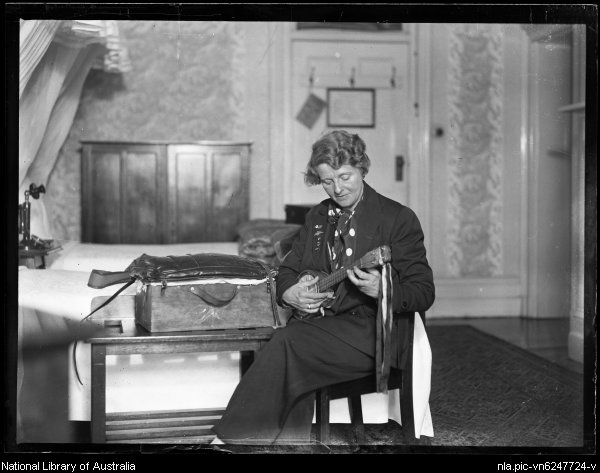
In Australia the ukulele gained popularity during the interwar period. It was appreciated as an entertainment by soldiers in a hospital for war veterans.  The Argus (Melbourne, Vic, 25 May 1932, p.6) newspaper reported that Lady Chaytor entertained the patients with her ukulele at the Caulfield Military Hospital.  Lady Chaytor was from County Durham, England and had flown to Australia as a passenger in a two seater Gypsy Moth to commence a series of lectures on fashion.  Her only luggage was one small suitcase and her ukulele.  She visited Caulfield Hospital saying “she felt that she was of the A.I.F., for her brother, who at an early age ran away from home, had enlisted from Queensland”.  She visited each of the wards, sat on the piano and sang many songs playing her ukulele and accompanied by the singing of the men.

nla.pic-vn6247724-v

Lady Chaytor with her ukulele in Sydney, Australia, 1932

During World War II George Formby is well-documented entertaining British and allied troops at the front with his banjo ukulele.  It is much harder to find photographs and videos of Australian troops being entertained by Australian ukulele performers.  Unlike Britain and America, Australia had only a small contingent of entertainers for the diggers during World War Two.  The ukulele appears to have been a more private instrument that men could take with them to the battlefield.

nla.mus-vn6607765-s1-v

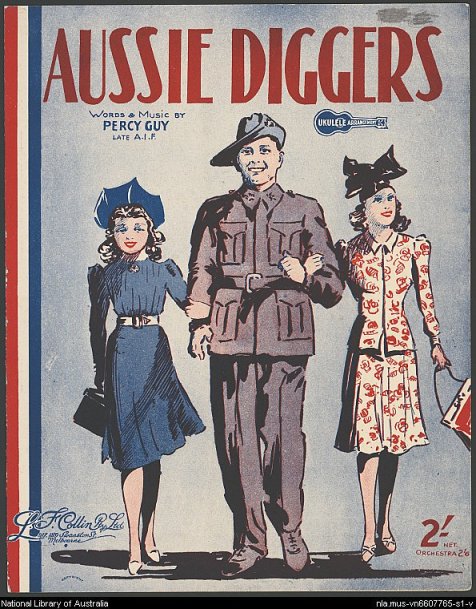
Sheet music for the ukulele became prolific and patriotic during World War Two.

The ukulele and music were very important to many American soldiers during their time in Australia.  Jack Earle an American gunner, was recovering in Perth from shell-shock.  For him music was “half his life”and he appealed for an instrument in the newspaper after losing two while on active duty.  It was quickly replaced the next day by an anonymous female donor  (Daily News, Perth W.A. Tues. 16 Sept. 1941, pg. 16) which was only possible due to the popularity of the ukulele in Australia.

USA Marines Ballarat 1943

U. S.  Marines with ukulele, Ballarat, circa. 1943, Charles Edward Boyles (National Library of Australia).


Adelaide

World War 2 Australian Soldier

P.O.W. Whittling Starts WA Ukulele Industry.

Boredom-killing whittling in Changi prisoner of war camp has started up an in-dustry in Western Australia that might become a dollar-earner.  Partner in JMG Industries at Jolimont Les O’Connell, filled in his spare time at Changi using a knife on coconut shells and pieces of tea chests to make a ukulele. Heartened by his success he made a carved top ukulele which musicians in the camp hailed as a topline instrument. O’Connell decided to go into the business on his liberation. This story was told today by his partner Jack Maskiell who was with O’Connell in Changi. He said that it took six months to produce the first local ukulele. From then on the ukuleles were marketed throughout Australia with great success. ‘We got a bit cheeky,’ said Maskiell. ‘We sent them to Singapore and Ceylon and now dollar-earning samples are in the U.S.. ‘We also have them in Britain.’ The firm has now produced 3000 ukuleles and 700 guitars…… Maskiell lost a leg in Changi. (The Daily News, Perth, 16 May 1950, pg. 9)


Rats of Tobruk Ukulele

Rats of Tobruk ukulele 1943

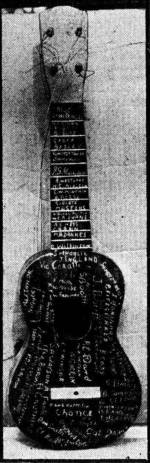
After the siege of the Garrison at the Libyan port of Tobruk in 1941 Ref. 3, this ukulele (pictured above) was adopted as a permanent record of the West Australian Battalion known as The Rats of Tobruk.  It was owned by a Corporal Smith and played before and during the siege, but became a memento of the event.  Pictures of rats were scratched at the headstock with the word Tobruk, then 200 signatures were scratched on the front and back of the ukulele by the men of the unit. It was returned to Western Australia after Corporal Smith was taken prisoner (Daily News, Perth, W.A. Wed, 21 April 1943, pg. 7).

More ukulele stories, photographs and artwork of Australian soldiers can be found in the Australian War Memorial.

The Australian War Memorial – “A Sentimental Song”

Soldiers 1941 – Australian War Memorial

Soldier in Hospital with ukulele – Australian War Memorial

Zilla

Bayside Ukes member.

I Took my Uke to a Party…

After several years of singing and playing the guitar I decided to buy a ukulele so that I would have a smaller, more portable instrument to carry around.  As seems to be the case for anyone who takes up this instrument, I became obsessed with the uke and had some lessons.  Then the fun really started.

Unlike in that old Gracie Fields song I Took My Harp to a Party but Nobody Asked Me to Play, you don’t need to hide your uke under your coat.  The little ukulele actually attracts an audience, as I discovered when I took my ukulele to play a few songs at a picnic with some friends.  After this great day, where we all had a lot of fun together, these friends began to ask me to bring the uke along to parties and other social events.  The happy nature of the ukulele sound seems to break down barriers and encourages people to participate and we would have sing-alongs with lots of laughter and conversation.  This also gave me the opportunity to perform some of my own songs, which I have been writing for years, in front of a non-threatening audience.

Playing the ukulele has opened up my life to new people and experiences, especially after becoming one of the founding members of Bayside Ukes, where I have met a great bunch of friendly ukulele obsessives like myself.  In belonging to this group, I have learnt so much from playing with others and have become more confident when performing before complete strangers.  Helping to organize a ukulele group has also allowed me to make a small contribution to my local community.

Now I have joined with a fellow ukulele devotee.  We sing harmonies and play pop songs together.  Recently we were asked to entertain around 60 people at a birthday party. After overcoming some pre-performance nerves we really enjoyed ourselves.  Afterwards another ukulele player, who we did not know, came up and said how much he liked our singing and playing and we had a wonderful chat about the joys and techniques of learning to play the uke.  We also inspired one guest to get their ukulele out of the cupboard.  The ukulele is a fantastic icebreaker, as so many people are just taking it up themselves or know someone who plays the uke.

Who would have thought that this small instrument could have such a big impact on one’s life?  So don’t sit at home with your ukulele.  Get out there and share your enjoyment of playing with others.  You never know where this will lead.

Kat

Bayside Ukes member


Start Your Working Day With a Ukulele Song

Play your ukulele on Monday the 14th March to celebrate the Labour Day Holiday in Victoria.

We have the Eight Hour Movement of 1856 to thank for introducing the eight hour day to Victoria.  The group advocated 8 hours of work, 8 hours of recreation and 8 hours of rest.  So let us celebrate those 8 hours of recreation that gives us the time and energy to play our ukuleles.

In 2015 a happy ukulele song really brightened up the morning journey to work for these commuters in Perth, Australia. What a great way to start the working day.

So get out there and play your ukulele.

Happy Labour Day, Melbourne and Victoria.

Zilla

Bayside Ukes Member

Bosko & Honey

If you  did not see Australia’s Got Talent on Sunday, you missed a fantastic performance by Bosko & Honey.  They did their song  Another Day In Paradise  and here is their hilarious video.   They received four Yes votes from the judges and are through to the semi-final.  As they are such great entertainers and generous participants at many ukulele festivals in Australia, let’s hope they do well in the competition.

Zilla

Bayside Ukes Member

10 Reasons Why Ukuleles and Dogs Mix

DSCN1097_2       images       DSCN2294 - Version 2     images-1

  1. Dogs do not remain puppies forever and leave your ukulele and tuner alone.
  2. Dogs want to share in the fun with you and your ukulele.
  3. Dogs love to sit with you while you are playing your ukulele.
  4. Dogs are music lovers and make a great audience.
  5. Dogs wag their tails in time with the music.
  6. Dogs sing along when you hit those high notes.
  7. Dogs never criticize your performance.
  8. Dogs do not care what genre of music you play.
  9. Dogs never tell you to be quiet and stop playing that uke.
  10. Dogs know that when you have finished your practice you will take them for a walk.

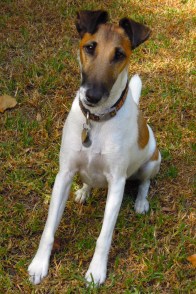
Note:  The above dog was well rewarded for taking part in this post.

Kat

Bayside Ukes Member

Happy New Year

-1174271647

Happy New Year to all our members and Welcome to our new website.

It was wonderful to finish 2015 with the group and solo performances at our  end of year party, and to see so many individual members entertain everyone with some new songs.

We look forward to many great ukulele sessions in 2016.

BaysideUkesLogo

Term Dates For The First Half of 2016

Term 1:  Tuesday 2nd February – Tuesday 22 March.

Term 2:  Tuesday 12th April – Tuesday 21st June