Two of the most common strumming patterns for ukulele are the Church Lick and the Calypso Strum. Many beginners may have come across these strums before but know them by no name or different names. If you wish to play with others or play more difficult songs it is important to know the name of the strum pattern being used.
Ukulele Mike has two good videos to demonstrate both of these strumming patterns and they are both in 4/4 time. He also stresses that you must practice both using a straight strum and a swing strum, to the extent that your “muscle memory” allows you to play them both ways automatically. Repetition is the key.
The Church Lick:
Can be written as:
down-down up / down-down up down-down up /
d.du / d.dud.du /
Ukulele Mike demonstrates this as a Straight 8th note strum and as a Swing 8th note strum. This is also useful for changing chords within a bar (Ukulele Hunt).
The Calypso Strum:
Can be written as:
1. / down-down up-up down up / down-down up-up down up /
2. / d.du.udu / d.du.udu /
The Calypso strum is also known as the Island Strum or for guitar players the Rock Strum. It is widely used in popular music and as Ukulele Mike explains in his video, can be played as a Straight 8th note strum or a Swing 8th note strum.
Both songs, He’s Got the World In His Hands and Jamaica Farewell, that Mike mentions as suitable for learning the Calypso strum are in The Ukulele Club Songbook.
On Anzac Day, the 25th of April, we remember Australians at war.
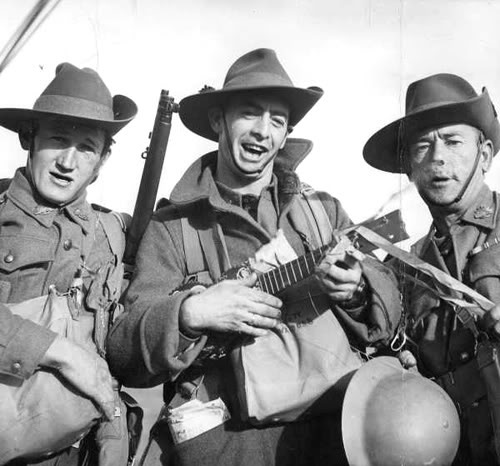
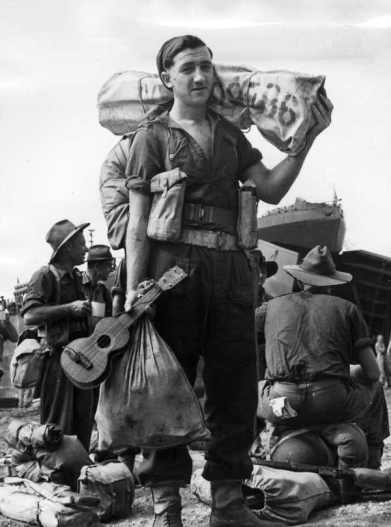
Although the ukulele was introduced to Australia before 1915, there is little evidence that it was played during World War One by Australian troops at Gallipoli or on the Western Front in Europe. It was not until after 1918 that the huge popularity of the ukulele in America ensured it spread to the rest of the world Ref. 1 . By World War Two Australian soldiers adopted the ukulele as part of their unofficial kit, as they tried to bring some cheer to their lives at camp and at the front.
In America during the 1920s and 1930s, Buster Keaton (and his ukulele), was an established star of silent movies and Cliff “Ukulele Ike” Edwards was famous as a singer and ukulele player in Vaudeville. Both starred in the film “Doughboys” (1930), that loosely depicts Keaton’s wartime experiences during his service in France during WWI Ref 2. One great scene shows Buster and Cliff playing the same ukulele while Cliff sings and Buster scats.
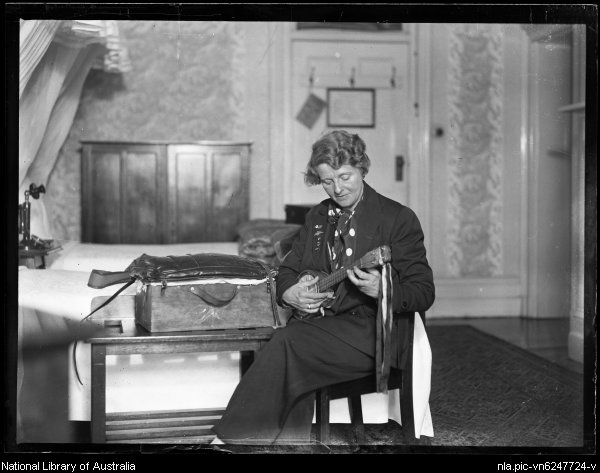
In Australia the ukulele gained popularity during the interwar period. It was appreciated as an entertainment by soldiers in a hospital for war veterans. The Argus (Melbourne, Vic, 25 May 1932, p.6) newspaper reported that Lady Chaytor entertained the patients with her ukulele at the Caulfield Military Hospital. Lady Chaytor was from County Durham, England and had flown to Australia as a passenger in a two seater Gypsy Moth to commence a series of lectures on fashion. Her only luggage was one small suitcase and her ukulele. She visited Caulfield Hospital saying “she felt that she was of the A.I.F., for her brother, who at an early age ran away from home, had enlisted from Queensland”. She visited each of the wards, sat on the piano and sang many songs playing her ukulele and accompanied by the singing of the men.
Lady Chaytor with her ukulele in Sydney, Australia, 1932
During World War II George Formby is well-documented entertaining British and allied troops at the front with his banjo ukulele. It is much harder to find photographs and videos of Australian troops being entertained by Australian ukulele performers. Unlike Britain and America, Australia had only a small contingent of entertainers for the diggers during World War Two. The ukulele appears to have been a more private instrument that men could take with them to the battlefield.
Sheet music for the ukulele became prolific and patriotic during World War Two.
The ukulele and music were very important to many American soldiers during their time in Australia. Jack Earle an American gunner, was recovering in Perth from shell-shock. For him music was “half his life”and he appealed for an instrument in the newspaper after losing two while on active duty. It was quickly replaced the next day by an anonymous female donor (Daily News, Perth W.A. Tues. 16 Sept. 1941, pg. 16) which was only possible due to the popularity of the ukulele in Australia.
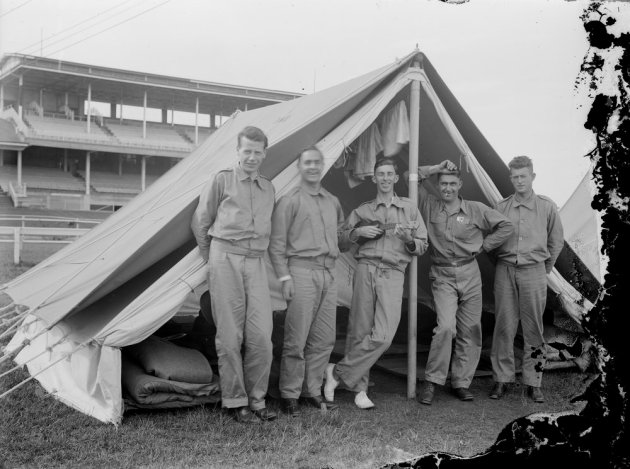
U. S. Marines with ukulele, Ballarat, circa. 1943, Charles Edward Boyles (National Library of Australia).
World War 2 Australian Soldier
P.O.W. Whittling Starts WA Ukulele Industry.
Boredom-killing whittling in Changi prisoner of war camp has started up an in-dustry in Western Australia that might become a dollar-earner. Partner in JMG Industries at Jolimont Les O’Connell, filled in his spare time at Changi using a knife on coconut shells and pieces of tea chests to make a ukulele. Heartened by his success he made a carved top ukulele which musicians in the camp hailed as a topline instrument. O’Connell decided to go into the business on his liberation. This story was told today by his partner Jack Maskiell who was with O’Connell in Changi. He said that it took six months to produce the first local ukulele. From then on the ukuleles were marketed throughout Australia with great success. ‘We got a bit cheeky,’ said Maskiell. ‘We sent them to Singapore and Ceylon and now dollar-earning samples are in the U.S.. ‘We also have them in Britain.’ The firm has now produced 3000 ukuleles and 700 guitars…… Maskiell lost a leg in Changi. (The Daily News, Perth, 16 May 1950, pg. 9)
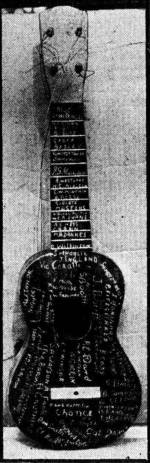
Rats of Tobruk ukulele 1943
After the siege of the Garrison at the Libyan port of Tobruk in 1941 Ref. 3, this ukulele (pictured above) was adopted as a permanent record of the West Australian Battalion known as The Rats of Tobruk. It was owned by a Corporal Smith and played before and during the siege, but became a memento of the event. Pictures of rats were scratched at the headstock with the word Tobruk, then 200 signatures were scratched on the front and back of the ukulele by the men of the unit. It was returned to Western Australia after Corporal Smith was taken prisoner (Daily News, Perth, W.A. Wed, 21 April 1943, pg. 7).
More ukulele stories, photographs and artwork of Australian soldiers can be found in the Australian War Memorial.
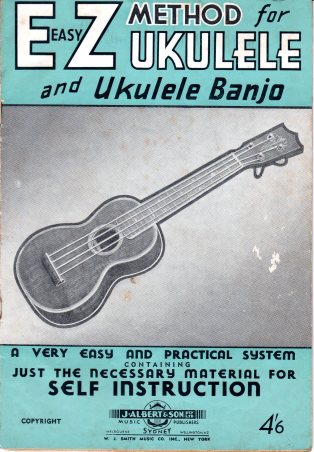
For ukulele aficionados out there, I have discovered a very old uke music book. I was going through my late mother’s music collection and found this:
” The E easy Z
METHOD FOR UKULELE AND UKULELE-BANJO
A very easy and practical system
containing just the necessary material for
SELF-INSTRUCTION.”
Mum was a classical and Jazz pianist in the 1930s and played professionally. I am not sure why she had a uke book. It was probably for someone in the band. It cost four shillings and sixpence or eleven pence posted. This edition was published in Australia by J. Albert & Son Pty Ltd, Sydney, circa. 1935. While the manual has the original copyright for W. J. Smith Music Co. Inc., New York for 1924, it also has two illustrations with the copyright for 1934 and 1935. It must have been an effective teaching method because it is still in print and new editions of this book can be found online.
Interestingly, the tuning of the strings was different: ADF#B. Apparently this was popular in the 1920s and 1930s and considered to make the uke sound brighter and more compatible with guitar chords if you were playing in a band. This would be like playing from the third fret of the soprano ukulele tuned to GCEA.
The book contains a mixture of traditional and old popular songs, including Play It On Your Little Uke.
The EZ method was also considered suitable for other instruments such as the Tiple, Uke-I-Tar, Guitar-Uke, Taropatch. In the book it says that the Guitar-Uke and Uke-I-Tar are other names for the Tenor Guitar that is played like a ukulele. The Taropatch has 4 pairs of strings, each pair tuned to the same note. The Tiple (Tee-plee) is a ten stringed instrument played in pairs or triplets.
A story aside… On the same day I discovered the uke book, I was looking at an old book of Mendelssohn Concertos that my Mum played and three fifty-dollar notes fell out. Paper notes in fact and probably from the 1980s. Imagine? A voice from the grave I reckoned.
Now I am a pretty average uke player, so my tips are not really for the experts, but I play ‘easy’ as they say. My sorry old fingers don’t always reach with appropriate pressure to give a good sound. So I cheat a little. I frequently only play the bottom 2 or 3 strings of a chord, making sure to only strum those strings accordingly. It works very well for say an F Minor or B Flat, or B and many others. This depends on your own fingering capabilities really. Really handy for quick changes and not really noticed in group playing!
Another tip I’m working on is Substitute Chords. Playing at home some of the chords I read are seemingly impossible, or infrequently used and easily forgotten. You can play around and get ‘close’. Once again I’m cheating. For instance G Minor instead of B Flat 7, or C9 instead of EM7 Flat 5. I’m sure many folk know many more. But have a play and see how you go!
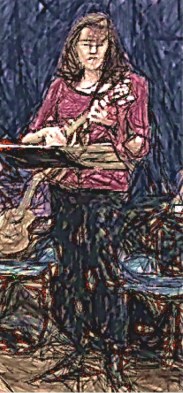
Many players always sit when they are playing their ukuleles. While this is fine when doing this for your own pleasure or at ukulele group sessions, it is not ideal in a performance situation and it is better for you physically to stand.
We are repeatedly being told by health care professionals that sitting around for long periods is bad for our health and that it is important to keep moving. Sitting for a long time can make you feel more tired than when doing some physical activity. Playing the ukulele standing up allows your body to move easily in time to the music and is a fun way to lessen sedentary behavior. In addition, it is more difficult to sing strongly in a sitting position because this can constrict the diaphragm. When standing up you can take deeper breaths and it is easier to sing and maintain breath control, something that is also good for the health.
In a performance situation it is usually necessary to stand, especially when playing with a large group that takes up the whole stage or where there are several players on a small stage. Often there is not enough room for everyone to sit, or a supply of chairs to make this possible. If there is no stage at all or one that is low, standing puts the players above the audience and makes it possible to connect with those beyond the front row. It is easier when standing to share music stands amongst several people if needed. This also allows different song leaders on a set list to change positions on stage without any fuss.
Some people find it difficult to play standing up, often because they find it hard to hold their ukulele without resting it on their seated body. It can be tricky balancing your uke without any support, especially the larger sizes, so the obvious solution is to buy a strap. If you have a strap button at the base of the uke, you can use the kind that is a smaller version of a guitar strap and tie the top end under the strings above the neck. Also smaller Mandolin straps are sometimes suitable.
If there is no button on your ukulele it is not recommended that you have one attached, as there might by no internal support into which you can drill the hole. Doing so might cause damage to the body of the ukulele and rather than taking this risk it is better to use the kind of strap that hangs around your neck with an end that hooks into the sound hole to hold the uke. Various types of ukulele straps can be purchased from the same music stores that sell ukuleles, or you can choose from the vast assortment to be found online. Having a strap will allow you to learn to play the ukulele in the standing position and contribute to your enjoyment and performances.
You can build up your stamina by standing for short periods, then increasing the length of time as you get used to this position. Once you can play the ukulele while standing, you will find it is much more fun to be able to move around with the uke, and you will feel more energetic and healthier as a result.
Note: If you need to sit for health reasons make sure that you have frequent breaks from playing and move around.
After several years of singing and playing the guitar I decided to buy a ukulele so that I would have a smaller, more portable instrument to carry around. As seems to be the case for anyone who takes up this instrument, I became obsessed with the uke and had some lessons. Then the fun really started.
Unlike in that old Gracie Fields song I Took My Harp to a Party but Nobody Asked Me to Play, you don’t need to hide your uke under your coat. The little ukulele actually attracts an audience, as I discovered when I took my ukulele to play a few songs at a picnic with some friends. After this great day, where we all had a lot of fun together, these friends began to ask me to bring the uke along to parties and other social events. The happy nature of the ukulele sound seems to break down barriers and encourages people to participate and we would have sing-alongs with lots of laughter and conversation. This also gave me the opportunity to perform some of my own songs, which I have been writing for years, in front of a non-threatening audience.
Playing the ukulele has opened up my life to new people and experiences, especially after becoming one of the founding members of Bayside Ukes, where I have met a great bunch of friendly ukulele obsessives like myself. In belonging to this group, I have learnt so much from playing with others and have become more confident when performing before complete strangers. Helping to organize a ukulele group has also allowed me to make a small contribution to my local community.
Now I have joined with a fellow ukulele devotee. We sing harmonies and play pop songs together. Recently we were asked to entertain around 60 people at a birthday party. After overcoming some pre-performance nerves we really enjoyed ourselves. Afterwards another ukulele player, who we did not know, came up and said how much he liked our singing and playing and we had a wonderful chat about the joys and techniques of learning to play the uke. We also inspired one guest to get their ukulele out of the cupboard. The ukulele is a fantastic icebreaker, as so many people are just taking it up themselves or know someone who plays the uke.
Who would have thought that this small instrument could have such a big impact on one’s life? So don’t sit at home with your ukulele. Get out there and share your enjoyment of playing with others. You never know where this will lead.
Being a self-taught uke player (ukist?), I found there hasn’t been any shortage of help on the web for learning techniques of playing. Ukists around the world are generous beings, sharing their skills and knowledge to help their fellow humans join the fraternity of world ukists.
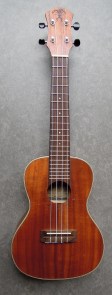
There is, however, a shortage of information on one matter: uke sizes. I’m not talking about the difference in size between soprano, concert and tenor ukes. That info is widely available. I’m talking about the variation in size between ukes of different brands and how this can impact on the player.
The first uke I ever bought was a tenor Lanikai. I bought it online (from a local store) and was very happy with it. In fact, this is the uke I use mostly today. After having this instrument sit in a green Woolworths shopping bag for months, I decided to buy it a proper home. So I ordered a tenor uke gig bag from the same shop. When it arrived in the post, I was quite cross when I discovered it was the wrong size for my uke – it was way too small. When I rang the shop, they told me that it was definitely a bag for a tenor uke, however, I was told that it was common knowledge (!) that Lanikai ukes are larger than the standard uke. Luckily enough, the music store was kind enough to swap it over with a case (a better quality one, at that) which fitted my slightly over-sized uke. Moral of the story, always take your uke along when buying it a new case.
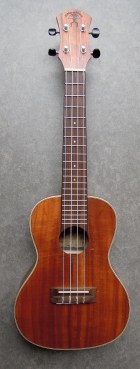
There is yet another sizing matter people need to know about. After fitting my Lanikai with a low G string (my preference for playing strummed chords), I bought a different brand uke so that I could keep the high G on it to play tabs that need a high G. I tested out ukes during a local uke festival. Price right, tone good, so I bought the uke (it also came with a bag!). I’ve been taking this uke out from time to time when I have the urge to play something more complex. Trouble is, I wasn’t really getting much better at the harder tabs. Then I realised that part of the issue wasn’t me – my newer uke actually has a much wider neck and fingerboard than my Lanikai. I measured the fingerboard of the new uke at the nut and it was 3.8cm, compare to 3.4cm on my trusted Lanikai. For someone with short fingers like me, this makes a real difference.
So why, you may ask, does a short-fingered person like me play tenor ukes? I was totally inspired by the sound made by Jake Shimabukuro on his tenor uke. Here’s one of my favourite performances of him playing his uke:
It’s not very likely that I’d ever play anything that complex – especially with the minimal amount of practice that I do – but hey, one can dream about it.
It is difficult to play your ukulele with a sleeping puppy on your lap.
You can find one string is missing when you are restringing your ukulele.
When you leave your ukulele clip-on tuner next to you on the sofa it will be stolen by your puppy and found in pieces.
It is not safe to leave your ukulele unattended with a teething puppy.
It is impossible to record yourself playing your ukulele when your puppy howls every time you press the record button.
It is impossible to play the ukulele with a jealous puppy pulling on your trouser leg.
It is impossible to play the ukulele in a comfortable chair while your puppy jumps on you repeatedly and stampedes around the room.
It is difficult to play the ukulele while your puppy gives you the sad-eyed treatment and drops a ball at your feet.
It is difficult to leave the house with your ukulele case because your puppy keeps trying to block your exit.
You know you have a problem when you leave your replacement ukulele tuner on a coffee table and find it has been eaten by your puppy and the remains have been taken into the garden for burial.
Note: No puppy was harmed from the ingestion of a battery, or performing any of the above actions.







 baysideukes.com